20 January 2012

BAHA Preservation Awards call for entries


Before
After

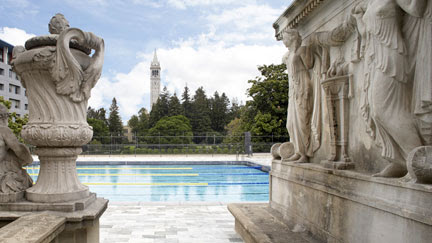
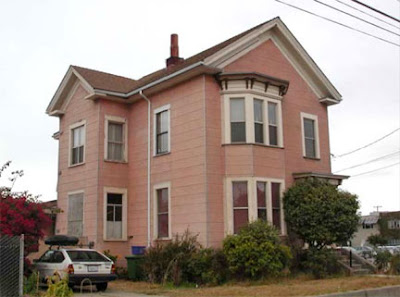
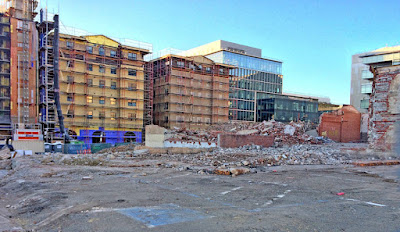
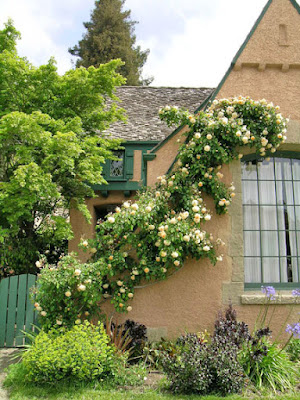
Now is the time to submit your nominations for the 2012 BAHA Preservation Awards. The deadline for submissions is 1 April. See the nominating instructions for submission requirements.

07 January 2012

February 2012 Fireside Lectures

Join us for a series of illustrated talks on three successive Thursdays in February 2012. All lectures will be presented at BAHA’s McCreary-Greer House, 2318 Durant Avenue, and will begin at 7:30 pm.

Seating is limited to 30, and advance ticket purchase is required. Admission $10 per lecture. Call (510) 841-2242 or e-mail baha@berkeleyheritage.com to reserve your seats. Mail check to BAHA, P.O. Box 1137, Berkeley, CA 94701, or pay via PayPal to expedite your order. See instructions for using PayPal (a handling charge will be added).


Western Hills cemetery (courtesy of Foster Goldstrom)

9 Feb. 2012   Sold Out
Maybeck & Morgan: An Enduring Association

Speaker: Daniella Thompson

The two titans of Bay Area architecture maintained a career-long friendship and collaborated on various projects—including several financed by the Hearst family—over a period that spanned 45 years.

Editor of the BAHA website and author of the article series East Bay: Then and Now, Daniella Thompson will review the history of Bernard Maybeck and Julia Morgan’s association and collaborations from the mid-1890s until 1940. The talk will be illustrated with rarely seen images.


Webb Block
Ruth House by Donald Olsen (photo: Dave Weinstein)

16 Feb. 2012   Sold Out
Berkeley: A Modern Mecca

Speaker: Dave Weinstein

Berkeley may be better known for brown-shingle bungalows than for flat-roofed, glass-walled, open-planned houses, but few cities anywhere boast an equal wealth of modern dwellings.

Dave Weinstein, author of Signature Architects of the San Francisco Bay Area, It Came from Berkeley: How Berkeley Changed the World, and the text for Berkeley Rocks, and senior writer for CA Modern magazine, will conduct an informal pictorial tour of the greatest modern residences in and around Berkeley.

We’ll see houses by Richard Neutra, Roger Lee, Henry Hill, and other masters, both well-known and little-known. We’ll see how many of these buildings pay homage to Bernard Maybeck, Julia Morgan, and other Bay Area innovators from an earlier generation. As a bonus, we’ll see some of the great, though often neglected and sometimes vilified, modern buildings on the Cal campus.


Normandy Village
50 Poppy Lane, designed by Katharine Gibbs Underhill (courtesy of Ann K.U. Tussing)

23 Feb. 2012   Sold Out
Family Stories: Living the Arts and Crafts Life in Berkeley

Speaker: Ann K. Underhill Tussing

Ann K. Underhill Tussing was born and raised in Berkeley, living her childhood in a house designed by her mother, Katharine Gibbs Underhill, a graduate of the California College of Arts and Crafts. Ann’s Gibbs and Underhill grandparents settled in the Berkeley Hills in houses designed, wholly or in part, by Bernard Maybeck, a family friend. Architectural plans of Maybeck’s Underhill House #2, Rose Walk, and two of Katharine Gibbs Underhill’s houses will be shown, as well as some exterior and interior photos.

Ann’s childhood was full of beauty and creativity, the natural setting of her home on a hillside lot with its redwood groves, dance lessons at the Temple of Wings, neighborhood theatrics, parties with the C.S. Forester family, learning to swim at the Berkeley Women’s City Club. There will be photos shown of these and other important parts of her families’ lives. Now she lives “East of Eden” in Syracuse, NY, where she has given this illustrated talk several times to the Arts & Crafts Society of Central New York. She is delighted to give it here, where it all began.

28 December 2011

2012 California Preservation Conference


Old Roots, New Growth—Cultivating Communities

Thursday, 3 May – Sunday, 6 May 2012
Oakland Marriott City Center


More than 30 sessions, tours, and workshops on issues facing California’s historic, cultural, and natural resources—taught by over 100 expert speakers, plus continuing education units are available for AIA, ASLA, USGBC, MCLE, and AICP.

Exclusive Tours that highlight Oakland’s architecture, landscapes, history, culture, and more.

Special Events at some of Oakland’s most historic and architecturally significant venues—including CPF’s signature event, the Three-Minute Success Stories.

For complete information, see the CPF website.

29 November 2011

BAHA’s Holiday Open House


Photo: Susan Cerny

Thursday, 8 December 2011
4 pm–7 pm
McCreary-Greer House
2318 Durant Avenue, Berkeley


Join us for some holiday cheer at BAHA’s annual December Open House. Meet your fellow BAHA members, find out what’s new at McCreary-Greer House, and enjoy light refreshments. Our gift shop will be open for your holiday shopping.

22 November 2011

Letter to the owners of the Sequoia Apartments


Sequoia Apartments (photo: Steven Finacom)

BAHA sent a letter today to the owners of the Sequoia Apartments building, 2441 Haste Street, which suffered a five-alarm fire on the night of 18 November 2011. Read the letter here.

24 October 2011

Color, by Karl Kardel

How paint colors and materials were done from the 1950s to the ’70s: not so easy then. It got a lot better for a few decades, but now it is near impossible to do.

I am really touched by the effort to save the colors at the North Berkeley Branch Library. Maybe a short review of color history I experienced will be of interest.

Not long after I came to U.C. Berkeley in 1959, I ran out of money, paying the extreme $700 or $800 in out-of-state tuition. I returned to painting and repairing homes to pay for my education, just as I did in Michigan during my high-school years, following my return from India after my father’s early death.

I was enthralled with the “library” of wonderful homes here, particularly the Craftsman homes. I found that the local living environment—versus the one where I grew up in Denmark (my family home), India, and Michigan—had become dull, maybe because of the depression and the Bauhaus influence, along with the political collectivization fist of the 1930s that dulled out much of the free spirit of architecture. Everything was gray, pink, beige, or white. That was it. And we have forgotten that Northern California really was an early source for the spirit we are trying to restore: recycling, local elements, sense of place, sense of human hands in our environment. It is no wonder that I ended up doing colors and finishes with Alice Waters up through today. We were all looking for a grounding of spirit then. Berkeley has led the world back to its values.

Around 1960, going into the Berkeley Dutch Boy paint store, I was told by the manager, “Son, you are a painter. We sell paint, you make the colors.” Well, I had been painting in oils since I was nine, so this was not a problem. But for the rest of the painters, getting “whatevercameoutofthecan” was the best option (just like food back then).

How were colors done then? A limited number of standard colors were available. All other colors were done by “boxing,” or intermixing standard colors together from can to can. Or mixing pigments that came in lead tubes. God help you if you ran out—you could never match it. Standard colors were basically gray, pink, blue, brown, or white; maybe a yellow. That was it.

Fuller Paints, a local manufacturer, made some ready-made trim enamels in very nice colors. Better still, Martin-Senour made great paints in deep colors for New England and colonial styles. But these were a tiny part of the market. This is where I cut my “color teeth” for fancy Berkeley homes. The colonial colors had a definite mathematical relationship; it was subtle but tricky.

In the 1950s and ’60s, we had many, many local paint stores.
Going east to west:
  • Fuller Paints, a local manufacturer—great paints
  • Pittsburgh Paints store
  • Morwear Paint, a local manufacturer
  • Boysen, a local manufacturer—great colors in enamels
  • Dutch Boy, a local manufacturer
  • Sherwin Williams
  • The Color Shop—mostly auto paints, but local
  • Triangle Paints, a local manufacturer
  • Davlin Paint Company, a local manufacturer
North to south:
  • The Color Shop, a local manufacturer
  • East Bay Paints—local
  • Marks Paint—local
  • L&H Paint Products—a local manufacturer
  • Dunn-Edwards Paints, a local manufacturer
  • Karldon—local but garbage
  • Sinclair Paint Company, a local manufacturer of very high-quality paint. It was bought out and closed down.
  • College Hardware
  • Martin-Senour Paints, the only really deep color supply, in great variety
  • Cal Ink used to be located in Berkeley on Fourth Street near Gilman. They made tints for paints and the printing industry.
Essentially, none of them remain. We still have:
  • Stiles Paint Manufacturing, the last independent in the Bay Area
  • Kelly-Moore Paints, who bought out some of the large independents that were left.
In days gone by, I could drive down the road and identify the paint manufacturer on the houses I passed.

Dutch Boy, now only a label in big box stores and a separate raw material manufacturer (NL Industries, as in National Lead…) used to have a plant locally. They had some good deep-color products. I would buy their errors at a dollar a gallon, and would experiment mixing them in barrels to get the colors I wanted. That is how I could afford doing colors, and my clients got them at less than half retail. Sometimes colors were mixed with pure acrylic that I got in barrels from Los Angeles, or augmented with stone powder. That is how I did the colors at Spruce and Eunice—I made the paints.


Lawrence L. Lucas cottages (1928), Spruce St. at Eunice St.

Color jobs in the late 1960s were considered subversive and undermining the social order; they were accepted when it was found that real estate was worth more when people liked where they lived. The Victorian color revival came out of this. I had to buy a few buildings to get it going. America at the time had forgotten the need to love where we live, the sense of place.

For a short decade, we had many manufacturers with tinting machines and ready-mixed, very deep colors in “mill” mixes. “Mill” mixes were finely ground into the vehicle-very true colors, and durable. Tinting machines cannot make pure colors, and they fade fast. Such efforts used expensive pigments and soon became unsupportable. Today, high-quality pigments are not available on the retail market; you have to go to specialty manufacturers for powder, or else industrial or automotive coatings. These finishes can run over $125 a gallon. Pigments like royal maroon, Chinese green, and many others are just unheard of.

Working on houses by Maybeck, who was a magician with color, or Henry Hill (little known now) who, while modern, had a grand palette, we had to resurrect colors where the pigments originally used were no longer available off the shelf. Henry Hill loved color, and the tints I needed in order to reproduce his colors cost many times the actual paint.

So for a colorist, it is hard. For metals, you can get great colors in automotive paint. The paint stores are staffed by people who don’t know the fundamentals and can’t match colors. They rely on computer matching, which does a barely adequate job. The clerks don’t get their hands wet. All the cans and the colors within are tinted and do not allow experimentation. They can’t touch the actual pigments—all are sealed. Deep pigments are expensive, or no longer mined. So, in some respects, it is harder now than when I started, because when you’re young, you can be subversive with the raw materials at hand. Today, the materials are not very available. For very special projects, it is possible, but it’s like a museum restoration effort.

After all these years, I still dream of making a paint out of lapis powder. I once saw a 500-year-old church done with lapis, it was still luminous.

KARL KARDEL

08 October 2011

Members’ reception at the Harris House


Photo: Daniella Thompson, 2011

The Joseph W. Harris House at 2300 Le Conte Avenue is Berkeley’s premier Streamline Moderne residence. Designed by John B. Anthony in 1936, it was designated a City of Berkeley Landmark in 1976.

Harris was the flamboynant haberdasher of “Call Me Joe” fame. His Berkeley Square store was also designed by Anthony.

The Harris House is on the market for the first time in decades, and BAHA members had a private champagne reception and early viewing of it today. We’ve posted some more photos on BAHA’s Facebook page.